Pages

Showing posts with label Harlan Kentucky. Show all posts

Tuesday, December 19, 2017

Mountain Memories -- Steel Saucer Sled

What was it every Appalachian kid dreamed about this time of year? Santa? Well, maybe. But what was the most important thing? Snow!

Snow--and lots of it--meant we could get out of school early for Christmas vacation. Snow meant we could have our fill of snowcream. But, most importantly, for some of us, it meant going sledding on the biggest hillside (or mountainside) we could find.


Near the bottom of the hill
I will never forget the Christmas morning my brother and I awoke to find a shiny, silver saucer sled under the Christmas tree. Now, we always got gifts from Santa, but they were rarely as awesome as that sled. Also, a deep snow had fallen on the mountain that week and still covered the mountain behind our house. We barely contained ourselves long enough to get bundled up before my brother grabbed the sled and shot out the back door.

My brother, Larry, being six years older, had control of the sled. He climbed up the hill where the garden is planted during the summer. That means it was mostly cleared of vegetation. I said mostly. Unfortunately, there were usually some corn stalks sticking up several inches, partially hidden by the snow. Also, the rows were a bit lumpy where mounds of dirt had been hoed across the hill.

Larry made it to the top, right next to a fence that separated our property from the family cemetery on the other side. He plopped down on the sled, grabbed hold of the handles, and rocked until the sled let go and flew down the mountain.

Coming down the hill
He screamed, "Woo-hoo," as he picked up speed. About that time, he hit one of those aforementioned protruding cornstalks and tumbled head over sled the rest of the way down the hill. I thought he would be a snowman, rolled up into the snow when he got to the bottom.


I squealed with laughter. Mom just squealed.

He built up so much speed as he rolled, that he didn't stop as the yard leveled out. He whammed into the back of the house with a big thud.

That's how our sled got its first dent.

We spent the day hiking up that hillside and sliding down. Often we took flight as we hit a cornstalk. Sometimes, we hit and tumbled. Each time we hit a row or built up dirt under the snow, we bounced on the steel sled. Our rears ached. It didn't matter. We laughed until our stomachs hurt. We mostly laughed at each other.

Taking flight as we hit a bump

After hours of trekking up that mountain, my face as red as Rudolph's nose and my fingers and feet numb from the cold, I decided it was time to take a break to eat and warm up. My brother continued sledding.

As the sun set behind the mountains and visibility became dim, which happens early in the mountains in winter, my mom went to the back door to call Larry inside for the day.

He ignored her.

As she started inside the house, she yelled up to him at the top the hill, next to the fence around the cemetery, "Larry, you'd better get inside before that little boy in the cemetery decides to ride on that sled with you."

He still ignored her as he completed his slide down the hill, grabbed the sled, and headed back up to the top.

Mom shook her head and came back inside.

A few minutes later we heard a loud crash into the back of the house. The door flew open and my brother whizzed into the house, slamming the door behind him. He stood in the doorway to the living room all red, covered in snow, panting, and staring with eyes as big as snowballs. He didn't say a word, just stood there.

He never told us what happened. However, Mom never had to tell him to come in before dusk ever again. As soon as the sun got near the ridge, he was inside, with the back door locked.


Did you have a saucer sled when you were a kid? Or did you use something else as a sled--like a car hood? Where did you ride it? Did you have a fabulous hill to slide down? Were there any wild adventures?

I'd love to hear your stories.

My brother, Larry, at the
bottom of the hill.
You can barely see the fence
to the cemetery 


Wednesday, December 6, 2017

Appalachian Word of the Week -- CHIFFEROBE

I'm sure you've heard of The Lion, the Witch, and the Wardrobe, but have you heard of a CHIFFEROBE?

A CHIFFEROBE was commonplace in the homes of Appalachia as I grew up. I remember them being a place of wonder and mystery. They had a key, you see. Only the possessor of that key was allowed to open the CHIFFEROBE.

Oh, the surmises my brain came up with about what was inside. What secrets could possibly be hidden behind that locked door?

I remember the one Granny had. I couldn't imagine what a granny would hide in that CHIFFEROBE. Unfortunately, I never discovered its secrets. I can only imagine.

Did she come from royalty and her jewed crown was hidden inside? Were there amazing ball gowns hidden away from a former life? Had she hidden a stash of money in there?

Key to CHIFFEROBE
It nearly drove me crazy as I stared into the mirror on the door and wondered what lived on the other side of that keyhole. And where did she hide that key?

Daddy had a CHIFFEROBE, too. Many times, I tugged on the door, hoping he had forgotten to lock it. No such luck.

What in the world would a man hide inside a locked CHIFFEROBE? What could he possibly hold so dear that it required a lock to keep everyone else out?

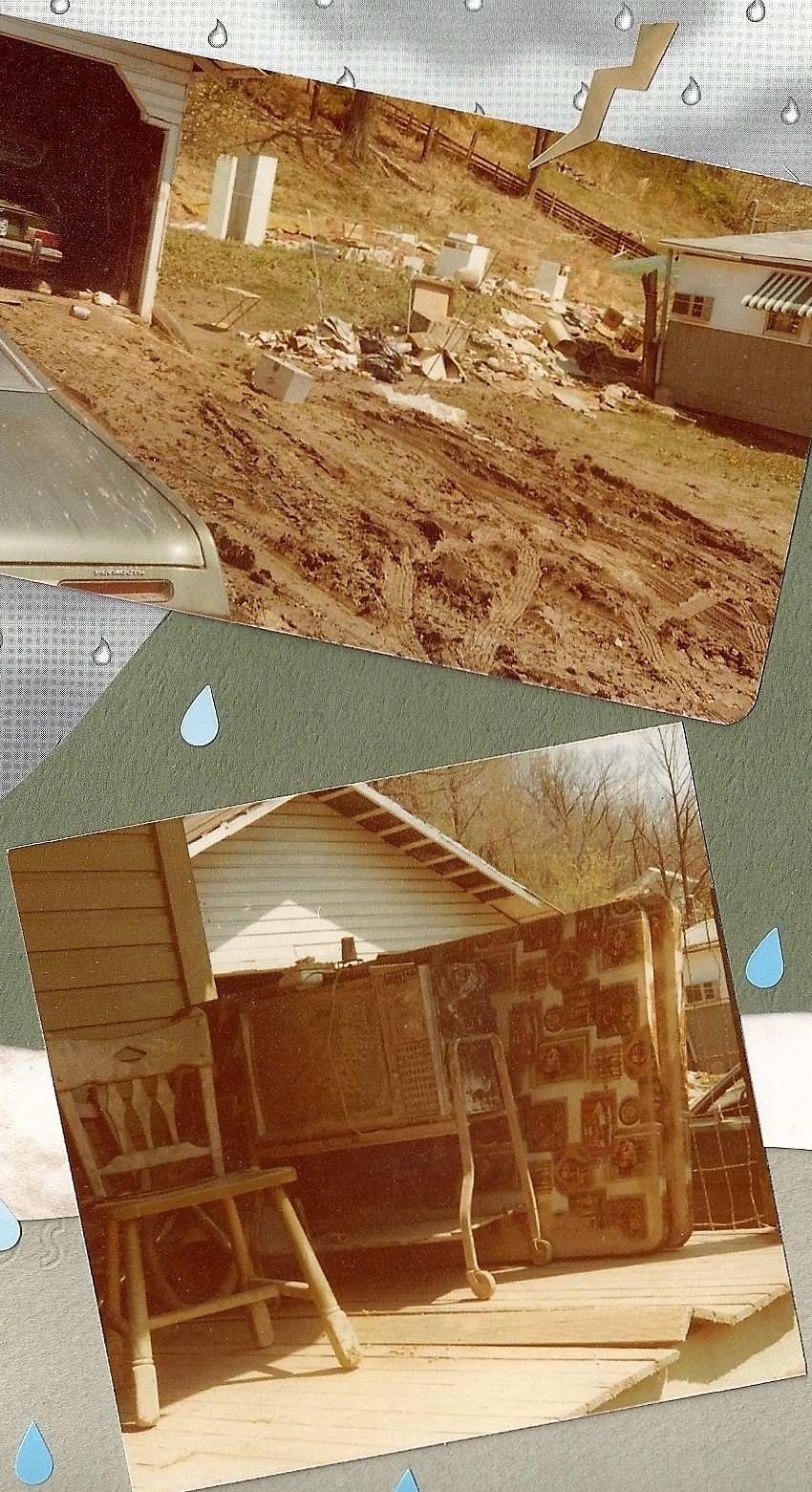
After the huge flood of 1977 swallowed our house and destroyed almost every possession we owned, I finally got to see the inside of Daddy's CHIFFEROBE.

Disappointment. Behind one door, he had a rod hanging with most of his clothes. Apparently, Mom took up all the room in the big closet with her clothes. On the floor of the CHIFFEROBE, he had his shoes stored.

Behind the clothes, in the corners, he had his guns--shotguns and rifles--for hunting. Of course, what I remember most is the day he came into the backyard while Mom was reclining in the sun and shot two HUGE black snakes out of the tree above her. She wasn't happy about that.

The other door of the CHIFFEROBE hid more interesting items. Instead of a rod for clothes, it had shelves and drawers. Papers, family photos, a few books, all his notebooks detailing every penny he ever spent and all family data (births, deaths, full names, some genealogy). I am fortunate enough to have one of those notebooks now. On the bottom shelf, he had some Mason jars of homemade wine he made from the grapes that grew wild on Laden Trail on Pine Mountain where he grew up. I had never seen my dad take a single drink of his wine.

The drawer on the bottom contained all kinds of trinkets and items he deemed necessary to save. Loose coins, screws and bolts, and things I didn't recognize. I did recognize his Greyhound safety awards, though. Each pin had a Greyhound dog (their logo) on it, the year he earned it, and a diamond, ruby, or sapphire under the dog's tummy. A few years after the flood, Mom took those pins to a jeweler and had the stones removed and reset into rings. I got one of the rings. It's my most prized possession.

The CHIFFEROBE Daddy built
When I was born, Daddy built a kid-sized version of a CHIFFEROBE just for me. He crafted it himself, in the apartment he and Mom lived in at the time, with a handsaw, sandpaper, and a hammer.

My CHIFFEROBE survived the flood and then a fire in my first apartment. It has lived in Kentucky, New York City, Ohio, Michigan, Maryland, South Carolina, Tennessee, and now in Georgia. It bears a few scars and smoke stains, but it still has most of its original glass knobs Daddy placed on it over 60 years ago. I still use my CHIFFEROBE every day.

Did you grow up with a CHIFFEROBE in your house? Do you have one now?

I'd love to hear your stories.

*Special thanks to Kay Ball for the top photo of her CHIFFEROBE.


Thursday, November 30, 2017

Appalachian Word of the Week -- AIRISH

You head out the door, thinking it is as warm as it was yesterday, and a cold blast of air whirls around you. Little daggers of ice stab you in the face and through the weave of your clothes. You shiver as chill bumps pop out all over you.

You decide to go back inside and grab a jacket -- and maybe a hat, scarf, and gloves. Then, maybe not, since you're a mountain man or woman and tough enough to handle a bit of AIRISH weather.

Many times while living in the mountains, I experienced some of those AIRISH mornings. They tend to arrive during the span of time between seasons. Of course, most of our winters were AIRISH all day long.

I live further south now, but I still experience a tad of AIRISH chill when I head out early or after dark during the in-between seasons. It's the wind that gets you and sends you scrambling indoors for a jacket.

Warm fire on an AIRISH morning
Even though we can usually ignore it and hurry to our destination, it helps to have a warm fire waiting inside when we arrive. Or a steaming cup of coffee or hot chocolate.

We crash through the front door, exclaiming in sounds that resemble a "brrrrr" and shake off the AIRISH chill like a dog shakes off rain. Then we head for the source of heat in the room as we hunch our shoulders and rub our hands together to warm up.

Someone in the room asks, "What'n the world's wrong with you?"

You reply, "Whoo-ee. It's a bit AIRISH out there."

Do you use the term AIRISH for chilly, windy weather? Did your family?

My dad used it often. He was a tough mountain man and being a bit AIRISH didn't stop him from doing what he needed to do. But he often warned the rest of us to dress warmly before heading out because it was a tad AIRISH.

Tell me your stories about AIRISH weather. Did you call it something else?

I need to turn up the thermostat. It's feeling a bit AIRISH in my house this morning.

Keep your critters warm on AIRISH days

Don't forget that your pets feel the AIRISH chill, too. Make sure you keep them warm on these AIRISH days.


Wednesday, October 11, 2017

Appalachian Word of the Week -- SIGOGGLIN

Do you know what it means for something to be SIGOGGLIN?

Origins of the word seem to originate from the Irish/Scottish heritage brought to the mountains of Appalachia (Apple-AT-cha). It means anything that is crooked, off-skew, or just plain wrong.

One of the most famous examples of SIGOGGLIN is the leaning tower of Pisa, Italy. I couldn't understand how something so wrong could be so famous. Seems that SIGOGGLIN buildings are a rage now. Go figure.

There were many examples of SIGOGGLIN when I grew up in Harlan County. Most people couldn't afford to hire a professional to build or fix things for them, so they took their limited know-how and did it themselves.

SIGOGGLIN door
Houses, fences, sheds, and your outside coal house could all make people wrinkle their noses, cock their heads, and say, "That's a bit SIGOGGLIN, ain't it?"

Of course, the mountain roads are all a bit SIGOGGLIN. I'll never forget traveling Laden Trail on Pine Mountain. That gravel road that wound around enough for you meet yourself going around a curve was a great example of a crooked SIGOGGLIN road.

I've met a lot of boys and men with SIGOGGLIN noses. They got that way from either meeting a fist nose on or from some crazy stunt where they ended up on the ground or against a wall nose first.

Ouch. That's gonna be a SIGOGGLIN nose
Back in grade school, our principal at Loyall made a point to tell us all NOT to slide on the icy streets at recess. My friend Jackie ignored the command. He left a fair share of blood on the ice as he slid down the street nose first.

The first time I tried to crochet, my project ended up SIGOGGLIN. I'm sure, with practice, I could have done better. But I gave up. My first cake ended up a bit SIGOGGLIN, too. Didn't affect the flavor, but it definitely looked a bit wrong.


Have you seen anything that's SIGOGGLIN?


Wednesday, October 4, 2017

Appalachian Word of the Week -- PERSIMMON


Every fall, my mother gave me the dire warning, "Don't eat a PERSIMMON before the first frost."

Of course, not heeding that warning would usually result in the PERSIMMON PUCKER.

That pucker was bad enough to make you never eat a PERSIMMON before its time ever again.

An unripe PERSIMMON has tannin in it. Tannin is the chemical that causes an astringent effect in your mouth. Tannin is bitter tasting and is what causes the skin inside your mouth to tighten -- making you pucker.

Basically, tannin can suck the moisture right out of you. It can feel like it's sucking the very life out of your body! Not a pleasant experience. Tannin is also what makes a dry wine dry. Fortunately, they don't use very much tannin in dry wine.

PERSIMMONS
However, when the PERSIMMON is ripe, there is very little tannin left and the fruit is extremely sweet.

My mom's warning about the first frost, however, was a tad unreliable. Although it's true that PERSIMMON is generally ripe starting in October (the time of the first frost in the mountains of Kentucky), not all PERSIMMONS are ripe immediately.

A better gauge of when you can avoid the tannin PERSIMMON PUCKER is when the flesh of the fruit is soft to the touch. It should feel like there is jelly inside the skin of the PERSIMMON. It will also have skin that looks a bit wrinkly.

I always ate PERSIMMON right from the tree. I made sure I used extreme care to make sure it was ripe enough. I only took a slight nibble to test it and hoped for a sweet taste instead of a nasty pucker.

PERSIMMON is also used for other eating pleasures. Some use them to make cakes and beverages. My friend, Michelle Medlock Adams, an award-winning author, creates a PERSIMMON pudding that is drool-worthy. Here is a photo of her latest creation. I've also included her recipe (for those of you who give me a hard time when I don't include recipes for the yummy foods I highlight on this blog).

PERSIMMON pudding
Photo courtesy of Michelle Medlock Adams 
Recipe courtesy of
Michelle Medlock Adams

PERSIMMONS have several other uses as well. The seeds are collected and sliced open each fall in an effort to predict the type of winter to expect. Inside the seed, you will either see a spoon, fork or knife. The spoon means there will be heavy snows (bad winter), the fork means the snows will be light, and the knife means it will be extremely cold.

PERSIMMON seeds are dark brown
The report is in and PERSIMMON seeds are displaying a SPOON this year. If you're in a snow-prone area, prepare for a snowy winter season.

The seeds can also be used for other purposes. If ground, a "tea" can be made. Interestingly, this tea was a coffee substitute for Confederate soldiers during the Civil War. The juices from the seeds can also be used as a gargle for sore throats and a cure for things like warts, cancers, heartburn, diarrhea, and stomach aches.

Who knew how amazing the little PERSIMMON could be?

Have you eaten a PERSIMMON straight from the tree? Have you ever experienced the PERSIMMON PUCKER?

I'd love to hear your stories.


Wednesday, September 20, 2017

Appalachian Word of the Week -- JAR FLY

Do you know what a JAR FLY is?

Did you ever hear them singing their song in the trees (their LOUD song) and search for them?

I loved to find them. And look at them. They were a fascinating bug. A BIG bug. With clear wings. That was the cool part of them for me.

But I never touched one. They were big, remember, and I was fearful of what must be big teeth inside them.

Now the problem with being afraid of something, especially if you have a brother, is that they think the greatest fun in the world is to catch the creature you are scared to death of and chase you around the neighborhood with it. Threatening to let it bite you.

My brother chased me with a JAR FLY
The JAR FLY, as we called it in Harlan County, is also called by other names in other locations. When I lived in Columbus, Ohio, I went outside one summer and the trees were alive with a similarly sounding bug. Not quite the JAR FLY song of my youth.

I soon learned they were Cicadas. Cicadas generally only show up every thirteen years or so.

The JAR FLY, however, comes every year, in the late summer. Some people call them DOG DAY CICADAS. Yes, they show up around August, during the dog days, and then disappear when autumn arrives.

I enjoyed the JAR FLY song. Some people complain that it is annoying.

Recently, in Atlanta, I walked outside and heard the familiar song coming from the Pine trees behind my house.

I smiled. Memories of youth rushed back. I even miss my brother being here to chase me around with a JAR FLY. If he was still alive, I might even let him catch me. Wonder what he would do. As I recall, he never caught up to me when we were kids. Probably on purpose.

Did you catch a JAR FLY when you were young? Do you hear them where you live today? Do you have a funny story about them?

If you'd like to see and hear a JAR FLY, click on the link below and it will take you to a Youtube video.

https://youtu.be/mah26og11ms


Wednesday, September 13, 2017

Appalachian Word of the Week -- GEE-TAR

Have you ever played a GEE-TAR?

There are several types of GEE-TAR. Acoustic, Electric, Electro-acoustic, Twelve-string, Archtop, Classical/Spanish, Flamenco, Steel, Resonator, Bass, Double-neck, Red-neck, and a few more.

Most of the GEE-TARS I knew of when I lived in the mountains were Acoustic. Of course, there were others being used a lot in Bluegrass, Country, and Gospel music.

GEE-TARs are quite versatile and easy to learn. If you don't mind getting sore fingers and calluses, that is. You can take them almost anywhere with you.

Playing GEE-TAR around the campfire
I remember going camping with church groups. Someone always brought a GEE-TAR so we could sit around a campfire and sing songs--right before someone started telling scary stories.

There's one type of GEE-TAR, though, that a lot of people don't know about unless they are fans of the old (as in my era) music of the Grand Old Opry style. I'm talking about the Hawahyer GEE-TAR. (That's Hawaiian Guitar for you city folks.)

My mom told me she used to play one. I never heard her because she didn't have the money to buy one just for her own entertainment. I thought it would be really cool to have a mom who played the Hawahyer GEE-TAR.

Some people also referred to them as a STEEL GEE-TAR. Or a SLIDE GEE-TAR.

I've given you a link here to listen to one in action: Click on the link. A blue bar will appear. Click on the blue bar and it will take you to the video.

https://youtu.be/k12JYrVGjLk

Do you love GEE-TAR music? What's your favorite type of GEE-TAR? Can you play?

I'd love to hear your stories.


Wednesday, September 6, 2017

Appalachian Word of the Week -- PAWPAW

Do you remember the song about sweet little Sally being way down yonder in the PAWPAW patch? We sang it often in my school.

Do you know what a PAWPAW is? Have you ever eaten one?

This time of year is harvesting season for the PAWPAW. I kept my eyes open for a PAWPAW tree while I visited my hometown of Harlan, Kentucky last weekend.

Unfortunately, I didn't find one and I'm not able to roam the mountains anymore to search for one growing up on Pine Mountain. Besides, the mountains are full of black bears, rattlesnakes, and copperheads these days.

I came home from my trip regretting I have to wait at least one more year before getting to sink my teeth into one of those luscious fruits.

PAWPAW tree
If you don't know about PAWPAW, I'll give you the details. They grow mostly wild on a scraggly looking tree with large leaves.

In appearance, they are similar to a mango. The flavor of a PAWPAW seems to be a combination of banana and mango. Of course, I never heard of a mango until I left the mountains. So, my only comparison to the flavor was a banana.

The flesh is smooth, sweet, and yellow/orange. Inside the PAWPAW you will find large dark seeds. You don't eat the seeds. Or the peeling. The peeling is a tad bitter.

A Harlan County friend
decorates with PAWPAW
leaves and Buckeyes
I remember fondly a friend of my daddy who had a PAWPAW tree growing in his yard in Loyall. Every August/September, we would stop by and pick a few from a tree he had growing in his back yard. I smile when I think of it.

I found a video on YouTube that describes the PAWPAW and current research on how to make them more marketable. Apparently, they are too delicate to sell in bulk at grocery stores. You can use the pulp, de-seeded and mushed, in recipes in the place of bananas. It can also be frozen for later.

Here's the link if you want to watch the video about PAWPAWS:

The PAWPAW

Have you ever eaten a PAWPAW? What did you think about it? Do you live where PAWPAWS grow today? Tell us about your PAWPAW experiences.

Wednesday, August 30, 2017

Appalachian Word of the Week -- VY-EENIES

Did you grow up eating VY-EENIE (Vienna) Sausages?

Whether you pronounce the name VY-EENIE, Vee-inner, or Vienna they were a staple in most of our homes. They were also handy to carry with you for a snack with a pack of Saltines.

Remember those little cans you had to open with a key to reveal seven perfectly formed sausages in a mostly clear juice?

I thought they looked like a flower stuffed into that can. A VY-EENIE weenie flower.

Capturing the first VY-EENIE
Of course, after getting the key to work on the can wasn't always an easy task. Neither was the next step--getting the first VY-EENIE out of the can. A fork helped. But if you didn't have a fork with you, you had to dig into the VY-EENIES with your fingers and wrestle one out.

VY-EENIES are the poor man's caviar. About as appetizing when I think about it now.

Funny how we didn't think about what was in those little sausages then. We just ate them. Now I realize how disgusting a combination of ingredients made up those beloved VY-EENIES.

Just one bit of a VY-EENIE
In spite of my new-found knowledge of the ingredients, I had to try one as I prepared this post. So I took one bite.

The memories flooded back.

However, I could only eat one bite as the gritty flavor lingered in my mouth.

Do you still eat VY-EENIES?

What do you call them? VY-EENIE sausages? VY-EENIE weenies? Vienna Sausages?

Love or hate?

We want to know.

Wednesday, July 26, 2017

Appalachian Word of the Week - GAUMED UP

Have you ever heard the term GAUMED or GAUMED UP?

Although it can refer to a lot of things, my dad used it most when he worked on his cars.

He would go out and buy a car from somebody for practically nothing and tow it home by a rope or chain. They very rarely ran, so he couldn't drive it into place in the garage to work on it. Somehow, he managed to successfully get it into our driveway and positioned just right in our little garage. He had to either back into it and push it backwards with a car that ran or get out and push it in--all by himself. My dad wasn't very tall, about 5 foot 6, but he was a determined sot. Sweat was his cologne.

I remember watching him as he started working on a new car. He rigged a wench in the garage to pull the engine out of the car so he could get access to everything. As he took the engine apart, piece by piece, he complained. "Just look at that mess. It's all GAUMED UP. That man didn't know how to take care of a car.
Dad used gas to get things UNGAUMED

Then he'd get his gasoline can, an old worn out t-shirt he had ripped into rags, and a stiff metal brush and go to town cleaning the GAUMED UP part. To me, it looked like black sludge. I didn't think he could ever get it clean, but he did. By the time he finished, that engine was shiny and new looking. No GAUM anywhere. He always got it running, too.

When he ran out of gasoline, instead of going out to buy some more, he'd siphon a bit out of his working car. I remember him sucking on that hose until he got the gas coming out into the can. Then he'd commence to spittin' and sputterin' until he got the gas out of his mouth. Nothing stopped my dad. Not gasoline in his mouth or GAUM in his car.

Of course, GAUMED doesn't only refer to filthy grease or caked on crud in cars.

GAUMED UP house
after the flood of '77
I remember how our house and yard got GAUMED UP after the flood of 1977. It was a real mess. All the furniture was GAUMED UP with river sludge. Actually, the entire house was GAUMED UP with it until Daddy took up some floor boards and shoveled it under the house. Then he nailed the boards back in place. He and Mom scrubbed the GAUM off of the walls and floors and hosed down the house, inside and out.

Children have a special gift for gettin' GAUMED UP with food and anything dirty. My little sister had a knack for gettin' GAUMED UP with her food. It was especially disgusting when she got hold of peanut butter or chocolate.

A lot of adults get their houses or storage buildings all GAUMED UP with stuff they should have thrown away a long time ago. I suppose my son would put me into that category, too. I guess he'd be right. Seems the older I get, the more GAUMED UP my house becomes. My excuse is that it's getting too difficult for me to gather it up and UNGAUM my life on my own steam.

GAUMED UP house
Do you have things that have GAUMED UP your life? How about we all try to get UNGAUMED a little bit this year? It can be the nastiness that needs to be cleaned up, the stuff that slows us down and keeps us from being productive, or it could be the GAUMED UP relationships that make our lives miserable. If those GAUMED UP people aren't willing to clean up themselves and keep trying to put a nasty GAUM all over us, maybe it's time we kicked them to the curb, too. Of course, we should first offer them some gasoline and a stiff wire brush to clean up their act.

WANT TO SHARE THIS TO TWITTER?

Appalachian Word of the Week - GAUMED UP (Click here to tweet)

Is your life all GAUMED UP? (Click here to tweet)


Wednesday, July 12, 2017

Appalachian Word of the Week -- LIGHTNING BUGS

You're a child in the mountains of Kentucky and the sun is setting above the western ridge. You've spent the summer day playing games, going fishing on the Cumberland River, walking or riding your bike to meet up with friends, reading a book, or another way of whiling away a steamy summer day.

With the setting of the sun, though, comes one of your favorite activities. Catching LIGHTNING BUGS. You get an empty Avon jar from your mother or a mason jar. I liked the Avon jars best because they were usually translucent white, pink, or another color and when you put your LIGHTNING BUGS inside, the entire jar glowed.

Giggles filled the growing darkness as you and your friends rushed across the yard to locate the last flash you saw and swoop up another LIGHTNING BUG.

One thing I learned quickly about LIGHTNING BUGS--they stink. When you get them on your fingers, your hands stink like crazy. But it didn't matter. We ran across a lot of stinky things in the mountains.

LIGHTNING BUGS are blessings
After you gather your jar of LIGHTNING BUGS, you sit in the grass or on the porch swing, while other flying bugs are attracted to you from your sweat and take a bite out of you, and watch the miraculous show from a little bug.

When boredom sets in and you are tired of the biting bugs, someone comes up with a great idea--making sidewalk art out of the LIGHTNING BUGS.

Now I hate to admit I participated in this activity. It's a shame. It's also probably one reason why we don't have as many LIGHTNING BUGS these days as we did back then.

Usually, a boy started the whole thing by taking a LIGHTNING BUG and smearing its glowing tail across the concrete, road, or front porch. I admit it was pretty to see it glow like neon glitter. But, it also meant the death of a LIGHTNING BUG. The evening darkness helped us ignore that part of it. We wanted to see the pretty glow.

When mamas called the children inside for the night to take a bath and wash off the grime of the day, I often took my jar inside and placed it beside my bed so I could watch them flash as I drifted off to sleep. My nightlight. The next day, I took my LIGHTNING BUGS outside and released them to flash again.

LIGHTNING BUG earrings
Recently, my first book of Appalachian Fiction sold. The publishing company's name is Firefly Southern Fiction. I thought that only fitting. I recently celebrated my dream-come-true by purchasing a new pair of earrings. LIGHTNING BUGS, of course.

Did you catch LIGHTNING BUGS as a child? Did you slime the sidewalk with LIGHTNING BUG essence and murder them? Did you teach your children about the glories of LIGHTNING BUGS?

TWEETABLES -- Want to share this post on Twitter? Just click on a link below

Appalachian Word of the Week -- LIGHTNING BUGS -- Click to Tweet

Did you catch LIGHTNING BUGS as a child? -- Click to Tweet


Wednesday, June 28, 2017

Appalachian Word of the Week -- QUEERY

Do you know what a QUEERY is? How about if I spell it the way it is on paper? QUARRY. Yep, some people also call it a GRAVEL PIT. But I always thought it was a QUEERY until I left Harlan County.

My experience with a QUEERY was the one on top of Pine Mountain in Harlan County. When we visited my grandmother, who lived right down the road from the Pine Mountain Settlement School, we sometimes took the paved road (instead of the graveled, hair-pin turned, one-laned Laden Trail).

On the main road, we passed the QUEERY. If they weren't working and it was a fairly decent day, we sometimes stopped to take a look inside. That place was HUGE! I loved standing there and yelling to hear my voice echo off the sheer stone walls.

Sparkly Quartz from the QUEERY
I also loved walking around inside and looking for gravel remnants that had a little sparkle to them. Limestone, the type of QUEERY we had, contained a lot of quartz. What joy when I could wander around inside the QUEERY and load my pockets with sparkly quartz-infused gravel. At home, I gathered my rocks, dipped them in water, and watched them sparkle as I turned them in the bright summer sun.


Fossil fern from the QUEERY
Limestone also contained fossils. What fun when I came across an ancient fern or creature that left its impression in the stone. I could have spent the entire day roaming around and picking up treasures from the QUEERY. Unfortunately, my young pockets would only hold a certain amount. That, and my parents weren't quite as excited about rocks as I was. My mother preferred diamonds.

This QUEERY is where my deep love and appreciation for rocks, minerals, and gemstones must have begun. I still swoon for anything that sparkles.

I remember the huge trucks that used to transport gravel from our QUEERY across the mountains. Smaller stones were used for roads and driveways. The Railroad workers spread larger ones up and down the miles and miles of railroad tracks as a base for the ties and rails.

Walking the tracks for Quartz rocks
Those railroad tracks and the sparkly rocks strewn there kept me walking the rails often during the warmer months. Of course, I came home with my pockets crammed with the sparkliest rocks I could find.

We have a QUEERY here in Atlanta. Sadly, they don't allow anyone to get anywhere near it. When I drive by, though, my mind travels back to that amazing QUEERY on top of Pine Mountain and the fun I had there as a child. Funny how the best memories of childhood are the ones that didn't cost a penny.

Did you ever visit a QUEERY?


Want to Tweet this post? Click on one of these:

Appalachian Word of the Week: Ever been to a QUEERY? (Click to Tweet)

Do you love things that sparkle? (Click to Tweet)


Wednesday, June 21, 2017

Appalachian Word of the Week - IN DUTCH

How many of you have been warned that you're "this" close to getting IN DUTCH? Do you know what it means? It means you've said or done something that causes disfavor with someone or is offensive. So, if you say or do something that irritates your parent, you will get IN DUTCH with them and they will respond in kind.

Was it a look your mom, dad or teacher gave you that warned you?

Did they make you go out and cut your own switch from the bush in the yard? If so, you knew you'd better get a good one, not a little wimpy twig, or mom or dad would go out and get one that wouldn't be so easy to forget.

Was the warning enough to set you on the straight course? Or did you test it to the limit?

My folks never used a belt, but I had friends who whispered about one being used in their homes. I wondered if their parents were ogres or if my friends were really dumb to break the rules even after their warning about getting IN DUTCH.

For me, all it took was my dad looking at me with that serious, but sorrowful hound dog expession on his face, pointing his finger, and saying, "You're gonna get IN DUTCH if you don't watch it."

One more second and you'll get IN DUTCH
All my mom had to do was look up at me (she was only 5 feet tall), with her head surrounded with metal-clamped pin-curls, and give me her basset-hound eyes. She was little, but she was a stick of dynamite that I never wanted to ignite.

Getting IN DUTCH, was the term used in my household for when we had almost gone too far. We knew it meant a whippin' if we crossed that line. I guess it was like our early warning system.

I almost always chose to heed that warning and stay out of DUTCH. My brother wasn't so smart.


You're gonna get IN DUTCH!

Thankfully, my son was smart and I rarely had to go beyond a warning that he was gonna get IN DUTCH. He learned his lessons quickly and well. Just like his mom.

Was IN DUTCH used in your house? Did you often find yourself IN DUTCH? How did your parents deal with your behavior that caused disfavor?

What did your parents call it when you were on the verge of getting the switch? (Be family rated here)


Tweetables:

You're gonna get IN DUTCH (Click here to tweet)

Appalachian Word of the Week - IN DUTCH (Click here to tweet)


Wednesday, June 14, 2017

Appalachian Word of the Week -- PICKLED BALONEY

One of my earliest memories is of a general store on top of Pine Mountain, Kentucky. On our way to my grandmother's rustic cabin hidden below the main road near the Pine Mountain Settlement School, we always stopped at the store. I still remember the bang of the screen door as we entered the dark room packed with an assortment of staples and foods. A cooler stood near the counter, humming as it cooled a variety of soft drinks (pop) -- Nehi Grape, Peach, Squirt, RC Cola, Coke, and Chocolate Soda come to mind.

A variety of sweets tempted me, but I skipped right past those to the rough-hewn wooden counter. Candy didn't cut it today.

The main reason we always stopped at this store sat on the end of the counter in a large glass jar with a red lid. A rope of PICKLED BALONEY.

My dad chatted with the proprietor as I anxiously waited for the big purchase. Finally, the grocer unscrewed the lid and pulled the PICKLED BALONEY rope out of the jar until my dad said, "That'll do." A knife neatly sliced the rope and he wrapped our piece in white butcher paper.

Saltines to tame the PICKLED BALONEY


I barely controlled my anticipation as Daddy paid for the PICKLED BALONEY and a sleeve of saltines (crackers).

Back in the car, Dad handed the PICKLED BALONEY to my mom to rip off a piece for each of us.

I grabbed my piece and peeled off the casing (pork gut) and bit into the PICKLED BALONEY. Heaven! Saltines were passed around, too, to calm down the pickled exuberance in the PICKLED BALONEY. The strong flavor of the pickling spices are what made it so glorious, but it was a tad strong on the tongue.

The last bite, with licks to my fingers, always brought sadness. I LOVED my PICKLED BALONEY.

I loved PICKLED BALONEY so much that I often received a jar of it (smaller than the one at the store) as one of my Christmas gifts.

My health has caused me to slow down on my PICKLED BALONEY consumption the past several years. I truly miss it. Thankfully, I don't have many options to be strong and resist its charm, since it's not as available in Georgia. But there are days when my mind wanders back to that dusty old country store and the joy I received from that PICKLED BALONEY. I truly believe it was the very best PICKLED BALONEY in the whole world.

My son never acquired a taste for PICKLED BALONEY. Whenever I ate it, he stood back and pinched his nose in disgust. PICKLED BALONEY never made it past his nose. Ah, well, it meant more for me.

Pickle some boiled eggs
You never throw out the juice from a jar of PICKLED BALONEY. It can be re-used. My mom often used it to pickle boiled eggs or beets. I imagine a few other things were pickled in that juice, too. I preferred PICKLED BALONEY.


Do you have a love affair with PICKLED BALONEY? Share your story.


TWEETABLES:

Do you have a love affair with PICKLED BALONEY? (Click here to tweet)

Appalachian Word of the Week - PICKLED BALONEY (Click here to tweet)


Wednesday, May 24, 2017

Appalachian Word of the Week -- CUT A SHINE

How many of you know how to CUT A SHINE? Do you know what it means?

My mom loved to CUT A SHINE. Unfortunately, my dad did not. She often told me stories of when she was younger, before she met my dad, and she and her girlfriends spent the weekend going to parties so they could CUT A SHINE.

There are all kinds of dances. My mom favored the jitterbug. I recall the days of The Twist and The Mashed Potato. I've lost touch with how the younger set CUTS A SHINE these days. Most of them look like all they need to do to CUT A SHINE is to gyrate to loud noise in between drinking and texting on their cell phones.

Fortunately, you don't have to have a partner to CUT A SHINE. Unless, of course, you're square dancing or doing one of the classic dances, such as the Tango. It takes two to Tango, you remember.

CUT A SHINE


I'm not able to CUT A SHINE these days with my arthritis. I miss it. There are times when I would love nothing more than to do a happy dance. I have figured out how to CUT A SHINE by doing a happy dance in my office chair. I can spin and flail my arms happily without falling on my face or having to call my chiropractor. There's always something to do a happy dance about if you look hard enough.

When my mom moved into her own apartment after my dad went into a nursing home, she had several opportunities to CUT A SHINE at events sponsored by her senior center. She loved it. It brought life back into her days.

Mom's last earthly chance to CUT A SHINE
She even CUT A SHINE a couple of weeks before her death. I'm glad she went happy.

I can see her in heaven getting to CUT A SHINE around the throne of Jesus. I'm sure she has found a few hairy-faced young men in the group to be her partner, too. 

Do you CUT A SHINE? What's your favorite dance?


Tweetables: